



THE PRACTICE TEST
Practice test at a glance
- Questions
- 500
- Format
- Multiple choice
- Access
- 2 years
- Price
- $29.99
- Answers
- Included
- Explanations
- Included
About these practice questions
These practice questions will help you prepare for the ASCP MLT exam.
This practice test contains 500 practice questions covering the seven sections of the ASCP MLT exam:
- Blood banking
- Urinalysis and other body fluids
- Chemistry
- Hematology
- Immunology
- Microbiology
- Laboratory operations
All questions have been carefully designed to reflect the questions on the real exam, to help you prepare and get a passing grade.
GET FULL ACCESS
Unlock the full practice test
ONLINE ACCESS
Unlock all 500 practice questions, answers and explanations.
- Immediate access after payment
- One question at a time in practice mode
- Jump directly to any question
- One-time payment
We'll send your purchase information to this address.
Payment is processed by PayPal.
TRY IT FIRST
Sample practice questions
Try some of the questions before buying. Answers and explanations are available with online access.
Section 1: Blood banking
Dosage The dosage effect is when an antigen reacts more strongly when there are two copies of a gene (homozygous) than when there is only one copy (heterozygous).Homozygous Position Prozone
Acetic acid Ethanol Normal saline Washed red cells are prepared by washing red cells with normal saline (0.9% NaCl), which removes most of the plasma.Sodium hydroxide
Albumin Plasma derivatives are proteins made by human plasma. They are made by pooling plasma from large numbers of donors and then separating the proteins from the plasma. Plasma derivatives include factor VII, factor VIII, factor IX, factor XIII, immune serum globulin, albumin, plasma protein fraction, Rho(D) immune globulin, synthetic volume expanders, and antithrombin III concentrates.Platelets Red blood cells White blood cells
To screen for fetomaternal hemorrhage in postpartum women The Rosette test screens for fetomaternal hemorrhage in postpartum women. The test is only performed on Rh-negative mothers who have given birth to Rh-positive babies. It helps determine if additional Rh immunoglobulin (RhIg) is necessary to prevent rhesus disease.To screen for red blood cell antibodies in donated blood To screen for the West Nile virus in donated blood To test for blood group incompatibility before hematopoietic stem cell transplantation
Rh+ mother, Rh+ fetus Rh+ mother, Rh− fetus Rh− mother, Rh+ fetus Hemolytic disease of the newborn can occur when the mother is Rh-negative and the fetus is Rh-positive. It can also occur through other blood group incompatibilities.Rh− mother, Rh− fetus
Black Gray Green Pink Pink top tubes contain EDTA as an anticoagulant and are preferred for blood banking.

1 2 The father and mother both have blood type AB, which means they each carry one A allele and one B allele. Because each child inherits one allele from each parent, the children will inherit the A or B allele from the father and the A or B allele from the mother. Therefore, the children have three possible genotypes: AA, AB, and BB.This is shown in the figure below. As seen in the figure, half the children would be expected to have the AB genotype (type AB blood), a quarter would be expected to have the genotype AA (type A blood), and the remaining quarter would be expected to have the genotype BB (type B blood).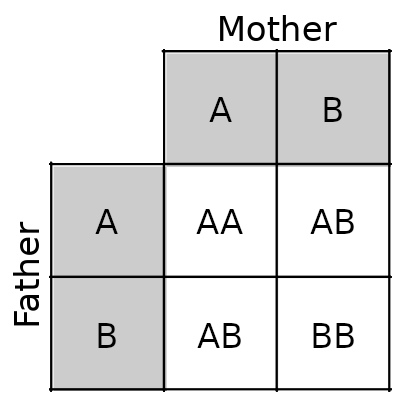
3 4
Acquired hemophilia A Acquired hemophilia A is a bleeding disorder caused by antibodies that block factor VIII. A laboratory-made form called recombinant porcine-sequence factor VIII can be used as treatment because the patient’s antibodies may react less strongly with it.Glanzmann thrombasthenia Immune thrombocytopenia Von Willebrand disease
By binding and neutralizing anti-D By blocking H1 receptors By blocking the IgD antigen-binding site By destroying fetal red blood cells in the mother's bloodstream Anti-D immunoglobulin injections help to prevent Rhesus disease in mothers and babies. The injections destroy any Rh-positive blood cells that cross over from the fetus's bloodstream to the mother's bloodstream during the pregnancy. This means the woman's blood does not have a chance to produce antibodies. This significantly decreases the risk of the next baby having Rhesus disease.
3% For a standard 70 kg adult, each unit of red blood cells typically increases the hematocrit level by 3%.6% 9% 12%
Frozen Irradiated Synthetic Washed Washed red blood cells are used for patients with severe allergic reactions to transfusion with standard red cells. Washing the red cells removes nearly all of the liquid plasma and donor proteins that trigger allergic reactions.
Ancylostoma duodenale Ancylostoma duodenale is a roundworm that infects the intestines.Giardia lamblia Giardia lamblia colonizes the small intestine.Plasmodium malariae Transfusion-associated infections are caused by pathogens in donated blood. Plasmodium malariae, a blood parasite, can cause transfusion-transmitted malaria. The other options are intestinal parasites, not blood parasites:Taenia saginata Taenia saginata is a tapeworm that infects the intestines.
Anti-D immunoglobulin injections Blood transfusion Blood transfusions should be avoided if possible in patients with warm autoimmune hemolytic anemia because transfused red cells may be rapidly destroyed.Corticosteroid administration Use of IV immunoglobulins
Hemolytic disease of the fetus and newborn The direct antiglobulin test detects antibodies bound to antigens on the surface of red blood cells. This is the case in hemolytic disease of the fetus and newborn, where the mother's anti-Rh antibodies attach to Rh antigens on the baby's red blood cells.Iron deficiency anemia Iron deficiency anemia is a lack of healthy red blood cells caused by a deficiency of iron.Myeloma Myeloma is a type of cancer.Sickle cell anemia Sickle cell anemia is caused by red blood cells that are crescent-shaped. The immune system is not involved.
AB+ AB– A– O– Group O is the universal donor for red blood cell donations. However, the situation is reversed with plasma donations: Group O plasma can only be transfused into group O recipients. Plasma does not need to be RhD compatible, as it is unlikely to cause RhD sensitisation. Therefore, O+ and O– patients can receive O+ plasma.
Fresh frozen plasma Platelets Platelets carry the highest risk of transfusion-associated sepsis because they are stored at 20–24°C, which allows bacteria to grow more readily than refrigerated storage.Washed erythrocytes Whole blood
AB+ AB− O+ O− O− red blood cells lack A, B, and D antigens, so they are the safest choice for transfusion when the patient’s blood type is unknown.
Centrifuged Frozen and deglycerolized Irradiated TA-GVHD is a rare but serious complication of blood transfusion caused by white blood cells in the transfused blood. The white blood cells recognize the patient receiving the blood as ‘different’ and cause a severe illness or death. Irradiation of the transfused blood prevents TA-GVHD because the radiation stops the white blood cells from being able to divide.Saline washed
AB+ AB− O+ O− Intrauterine transfusions provide red blood cells to a fetus when the mother's immune system is destroying the fetal red blood cells. Type O− red blood cells are usually used for these transfusions because they lack A, B, and D antigens.
Leukoextraction Leukorebation Leukoreduction Leukoreduction is the removal of white blood cells from donated blood.Leukotransference
Ready for all 500 questions?
Unlock the full practice testPREFER PAPER?
Get the printed book
The practice questions and answers are also available as a physical book from Amazon.com.

About the ASCP MLT exam
What is the ASCP MLT exam?
The ASCP Medical Laboratory Technician (MLT) exam assesses the knowledge required for intermediate-level medical laboratory roles. The American Society for Clinical Pathology (ASCP) administers the exam.
The exam consists of 100 multiple-choice questions and has a 2.5-hour time limit. Exam topics include blood banking, urinalysis, chemistry, hematology, immunology, microbiology, and laboratory operations.
The exam fee is $235.
Exam eligibility
Before you decide to take the ASCP MLT exam, you should first make sure you're eligible.
The exam has three eligibility routes. All routes require an associate degree and certification and/or work experience.
The three routes are:
- An associate degree (or 60 semester hours) and completion of an MLT program.
- An associate degree (or 60 semester hours) in chemistry and biology and completion of a 50-week U.S. military medical laboratory training course.
- An associate degree (or 60 semester hours) in chemistry and biology and three years of clinical laboratory work experience.
To take the ASCP MLT exam, you must meet the criteria for at least one of these three routes.
[ASCP applying and taking]Content areas
The questions on the ASCP MLT exam encompass seven content areas:
- Blood banking
- Urinalysis and other body fluids
- Chemistry
- Hematology
- Immunology
- Microbiology
- Laboratory operations
Focus your study efforts on just four content areas: Blood banking, Chemistry, Hematology and Microbiology. Together, these content areas are worth 80-85% of the exam. The other three content areas — Urinalysis, Immunology, and Laboratory Operations — are only worth 15-20% of the exam, so are not as important.
The following table shows the percentage distribution of the content areas assessed in the exam.
| Content area | Percentage of exam |
|---|---|
| 1. Blood banking | 15–20% |
| 2. Urinalysis and other body fluids | 5–10% |
| 3. Chemistry | 20–25% |
| 4. Hematology | 20–25% |
| 5. Immunology | 5–10% |
| 6. Microbiology | 15–20% |
| 7. Laboratory operations | 5–10% |
The next few pages will provide a detailed overview of each content area.
1. Blood banking
The first content area of the ASCP MLT exam is Blood banking. It is worth 15–20% of the exam. [ASCP MLS/MLT Blood banking]
2. Urinalysis and other body fluids
The second content area of the ASCP MLT exam is Urinalysis and other body fluids and is worth 5–10% of the exam.
[ASCP MLS/MLT Urinalysis and other body fluids]3. Chemistry
The third content area of the ASCP MLT exam is Chemistry and is worth 20–25% of the exam. [ASCP MLS/MLT Chemistry]
4. Hematology
The fourth content area of the ASCP MLT exam is Hematology and is worth 20–25% of the exam. [ASCP MLS/MLT Hematology]
5. Immunology
The fifth content area of the ASCP MLT exam is Immunology and is worth 5–10% of the exam. [ASCP MLS/MLT Immunology]
6. Microbiology
The sixth content area of the ASCP MLT exam is Microbiology and is worth 15–20% of the exam. [ASCP MLS/MLT Microbiology]
7. Laboratory operations
The final content area of the ASCP MLT exam is Laboratory operations and is worth 5–10% of the exam. [ASCP MLS/MLT Laboratory operations]


