X

Report a problem


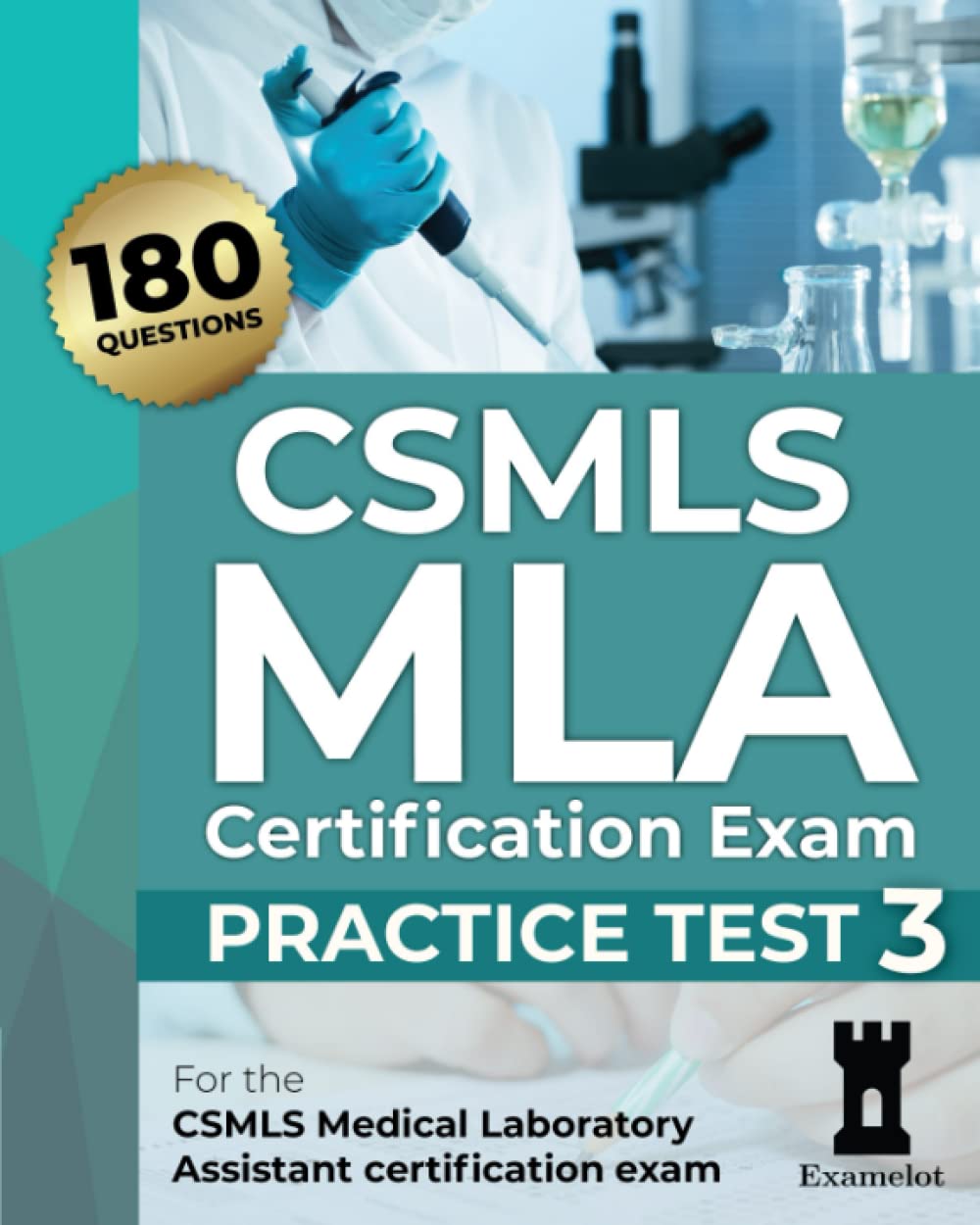
CSMLS MLA Certification Exam: Practice Test 3

This is a preview. Unlock all the questions and answers for just $19.99.

Buy now

About the CSMLS MLA exam

The CSMLS MLA Certification Exam is an examination for laboratory assistants in Canada. The exam is set by the CSMLS (Canadian Society for Medical Laboratory Science).

About these practice questions

These practice questions will help prepare you for the CSMLS MLA exam.

This page contains 180 practice questions divided into the eight sections of the exam: 1. Safe Work Practices, 2. Data and Specimen Collection and Handling, 3. Pre-analytical Procedures, 4. Reagent Preparation, 5. Communication and Interaction, 6. Quality Management, 7. Professional Practice, and 8. Critical Thinking.

All questions have been carefully designed to mimic the questions on the real exam, to help you prepare and get a passing grade.

Check out all the practice tests in this series: Practice Test 1, Practice Test 2, Practice Test 3, Practice Test 4, and Practice Test 5.

Sections

  1. Safe Work Practices
  2. Data and Specimen Collection and Handling
  3. Pre-analytical Procedures
  4. Reagent Preparation
  5. Communication and Interaction
  6. Quality Management
  7. Professional Practice
  8. Critical Thinking

Section 1: Safe Work Practices

1.1) What should you do if a patient faints during a venipuncture?
  1. Continue the procedure until all blood is collected
  2. Leave the needle in the vein and call the physician
  3. Remove the needle and attend to the patient
  4. Yell loudly at the patient to keep him conscious
Answers are locked. Please click here to buy them.
1.2) Which of these is a good laboratory safety rule?
  1. Leave a machine switched on when performing repairs
  2. Use one hand to carry testing samples, not two
  3. Wait until the end of the shift to clean up spills
  4. Wear safety goggles when working with strong chemicals
Answers are locked. Please click here to buy them.
1.3) What are "insidious" hazards?
  1. Hazards that are easily overlooked
  2. Hazards that happen slowly
  3. Hazards that involve chemicals
  4. Hazards that involve fumes
Answers are locked. Please click here to buy them.
1.4) Which of these liquids is flammable?
  1. Bleach
  2. Ethanol
  3. Nitric acid
  4. Saline
Answers are locked. Please click here to buy them.
1.5) Which rating of fire extinguisher is used in chemical fires?
  1. A
  2. B
  3. C
  4. D
Answers are locked. Please click here to buy them.
1.6) A fire extinguisher has the following symbol. This fire extinguisher:
  1. can be used on fires involving flammable liquids or gases
  2. requires annual top-ups of type B fuel
  3. should be stored in a separate room from flammable chemicals
  4. uses kerosene to extinguish fires
Answers are locked. Please click here to buy them.
1.7) What is this fire extinguisher called?
  1. ABC
  2. AFFF foam
  3. Carbon dioxide
  4. Class F
Answers are locked. Please click here to buy them.
1.8) Which fire extinguisher is best for electrical fires?
  1. ABC powder
  2. AFFF foam
  3. Carbon dioxide
  4. Dry powder
Answers are locked. Please click here to buy them.
1.9) What are the three components of the fire triangle?
  1. Oxygen, heat, and fuel
  2. Oxygen, ignition, and fuel
  3. Rescue, Alarm, Escape
  4. Rescue, Alarm, Extinguish
Answers are locked. Please click here to buy them.
1.10) Dry ice is dangerous because it burns, suffocates and:
  1. can explode
  2. catches fire when exposed to air
  3. causes viral infections
  4. is highly toxic
Answers are locked. Please click here to buy them.
1.11) Which of these is PPE?
  1. Fire extinguisher
  2. First aid kit
  3. Hand-washing station
  4. Lab coat
Answers are locked. Please click here to buy them.
1.12) In which of these situations should a lab technician remove their gloves?
  1. Before carrying specimens through a designated clean area
  2. Before loading the autoclave
  3. Before using a restroom
  4. For cleaning a chemical spill
Answers are locked. Please click here to buy them.
1.13) Which of these statements about nitrile gloves is true?
  1. Nitrile gloves are a good substitute for latex gloves
  2. Nitrile gloves are cheaper than latex gloves
  3. Nitrile gloves are less resistant to punctures than latex gloves
  4. Nitrile gloves are unsuitable for routine laboratory work
Answers are locked. Please click here to buy them.
1.14) What is post-exposure prophylaxis?
  1. An autoimmune disease
  2. The inability to breathe after exposure to an allergen
  3. The protocol for cleaning a laboratory after the release of a dangerous pathogen
  4. Treatment after exposure to a pathogen to prevent infection from occurring
Answers are locked. Please click here to buy them.
1.15) What does this pictogram mean?
  1. Flammable
  2. Oxidizing
  3. Self-heating
  4. Self-reactive
Answers are locked. Please click here to buy them.
1.16) What is the term for the destruction of all microorganisms, including spores?
  1. Disinfection
  2. Eradication
  3. Sanitation
  4. Sterilization
Answers are locked. Please click here to buy them.
1.17) A disinfectant may become ineffective if:
  1. it is kept in a dark place
  2. it is left at room temperature
  3. it is not diluted properly
  4. the container is kept tightly sealed during storage
Answers are locked. Please click here to buy them.
1.18) Which method of sterilization uses steam under pressure?
  1. Dry heat autoclaving
  2. Filtration
  3. Microwaving
  4. Moist heat autoclaving
Answers are locked. Please click here to buy them.
1.19) Ethanol can NOT kill:
  1. Pseudomonas aeruginosa
  2. Salmonella typhosa
  3. fungi
  4. spores
Answers are locked. Please click here to buy them.

Section 2: Data and Specimen Collection and Handling

Section 3: Pre-analytical Procedures

Section 4: Reagent Preparation

Section 5: Communication and Interaction

Section 6: Quality Management

Section 7: Professional Practice

Section 8: Critical Thinking

Access options

Get online access or buy a physical book.

Option 1: Online access

Unlock the answers to 180 questions for just $19.99

You'll get immediate access after payment.

Step 1

Enter the email address where you want us to send your order to.


Step 2

Select one of the payment buttons below.

Option 2: Physical book

Get the questions as a book

The questions and answers are available as a book at Amazon.com