THE PRACTICE TEST
Practice test at a glance
- Questions
- 181
- Format
- Multiple choice
- Access
- 2 years
- Price
- $19.99
- Answers
- Included
- Explanations
- Included
About these practice questions
These practice questions will help you prepare for the CSMLS MLA exam.
This practice test contains 181 practice questions covering the eight sections of the CSMLS MLA exam:
- Safe Work Practices
- Data and Specimen Collection and Handling
- Pre-analytical Procedures
- Reagent Preparation
- Communication and Interaction
- Quality Management
- Professional Practice
- Critical Thinking
All questions have been carefully designed to reflect the questions on the real exam, to help you prepare and get a passing grade.
GET FULL ACCESS
Unlock the full practice test
ONLINE ACCESS
Unlock all 181 practice questions, answers and explanations.
- Immediate access after payment
- One question at a time in practice mode
- Jump directly to any question
- One-time payment
We'll send your purchase information to this address.
Payment is processed by PayPal.
TRY IT FIRST
Sample practice questions
Try some of the questions before buying. Answers and explanations are available with online access.
Section 1: Safe Work Practices
Attention Caution Notice Warning The Globally Harmonized System (GHS) uses two signal words to indicate hazard severity:- "Danger" for severe hazards
- "Warning" for less severe hazards
In airtight containers Ethers form explosive peroxides when exposed to air and light. Therefore, ethers must be stored in the dark and in airtight containers.In the light In the refrigerator Underwater
In a fume hood In a flammables storage cabinet Methanol is highly flammable. It should be stored in an approved flammable liquid storage cabinet along with other flammable liquids.In a refrigerator On the bench top
be in English and French Under WHMIS 2015, supplier labels must be in both English and French. This ensures that all workers, regardless of their primary language, can understand the hazard information provided on the label.contain a photo of the hazardous product follow a set format While supplier labels must adhere to certain guidelines, there is no specific set format that they must follow. The label must include required elements, but the layout and design can vary.have a hatched border The hatched border was required under WHMIS 1988, but is no longer required under WHMIS 2015.
10% ethyl alcohol 40% ethyl alcohol 70% ethyl alcohol Alcohol is most effective as a disinfectant when it is diluted with water to a solution of 60–90% alcohol.100% ethyl alcohol
12 psi at 115°C 12 psi at 120°C 15 psi at 112°C 15 psi at 121°C Autoclaves use saturated steam under a pressure of approximately 15 pounds per square inch (psi) to achieve a chamber temperature of at least 250°F (121°C).
Air causes cold spots in the autoclave Air in an autoclave acts as an insulator and could cause cold spots. These cold spots can compromise the sterilization process.Air increases the risk of explosion Any water in the air will dilute the sterilizing agents Steam can break the glassware
Autoclave Autoclaves sterilize equipment by subjecting it to pressurized steam. In comparison, dry heat sterilizers and ovens use hot air for sterilization.Dry heat sterilizer Fume hood Oven
To avoid damaging the oven To ensure complete sterilization If you open a dry-heat sterilizer during sterilization, the sterilizer will cool slightly, and the temperature drop may interrupt sterilization. For this reason, it is important to keep a dry-heat sterilizer closed throughout the sterilization cycle.To prevent moisture from entering the chamber To prevent oxygen from entering the chamber
Acids Organic solvents Most organic solvents are highly flammable. Examples include ethanol, acetone, benzene, and toluene.Strong oxidizers Strong reducers
Fire alarms Fire extinguishers Fire-resistant walls Passive fire protection is built into the structure of the building and includes structural features such as fire-resistant walls, doors and floors. Active fire protection requires something to turn it on. Examples are alarms, sprinkler systems, and auto-closing ventilation in fume cupboards.Sprinklers
Carcinogen A carcinogen is any substance that can cause cancer in humans or animals. The word comes from carcino meaning "cancer" and gen meaning "causing".Caustic substance Nosocomial substance Pathogenic substance
1 minute 5 minutes 10 minutes 15 minutes In the event of a chemical splash to the eyes, the eyes should be flushed with water for at least 15 minutes. This is critical to prevent long-term damage to the eyes.
Proper handwashing Handwashing is the most important method for preventing infection. Hands come into contact with surfaces and objects throughout the day, picking up pathogens. Washing your hands with soap and water removes the pathogens, preventing their spread.Sneezing into your arm Thorough cleaning of equipment Wearing a lab coat
behaviour hospital-acquired infection reagent susceptible host The chain of infection describes the process of how an infection spreads. The steps are- infectious agent (virus, parasite, fungus, or bacterium)
- reservoir (the environment where a pathogen can live and multiply)
- portal of exit (how the pathogen leaves the reservoir)
- mode of transmission (how a pathogen moves from the reservoir to a host)
- portal of entry (where the pathogen enters the host, such as the mouth, the eyes, and wounds)
- susceptible host (the person at risk of infection)
Remove any unbroken tubes from the centrifuge Remove the broken pieces with tweezers Turn off the centrifuge You should first turn off the centrifuge and leave the lid closed for 30 minutes to allow any escaped aerosols to settle.Wipe the inner surface with disinfectant
Contact poison Neurotoxic agent Systemic toxin A systemic toxin affects the entire body or many organs rather than a specific site.Teratogen
Carbon monoxide poisoning Electromagnetic interference Explosions Skin burns Biosafety cabinets may have UV lamps to kill microorganisms. Be careful around UV lamps as they can burn your skin, damage your eyes, and cause skin cancer.
Section 2: Data and Specimen Collection and Handling
Postop complete blood count Preop pregnancy test Routine urinalysis Routine specimens have the lowest priority as no urgency or time requirement is involved. In general, the priority of specimens (from highest priority to lowest priority) is:- Stat
- Urgent
- Timed
- Preop
- Postop
- Fasting
- Routine
Timed glucose
Pre-op CBC Routine CBC Routine glucose Urgent CBC Urgent specimens are important and require expedited processing.
Ready for all 181 questions?
Unlock the full practice testPREFER PAPER?
Get the printed book
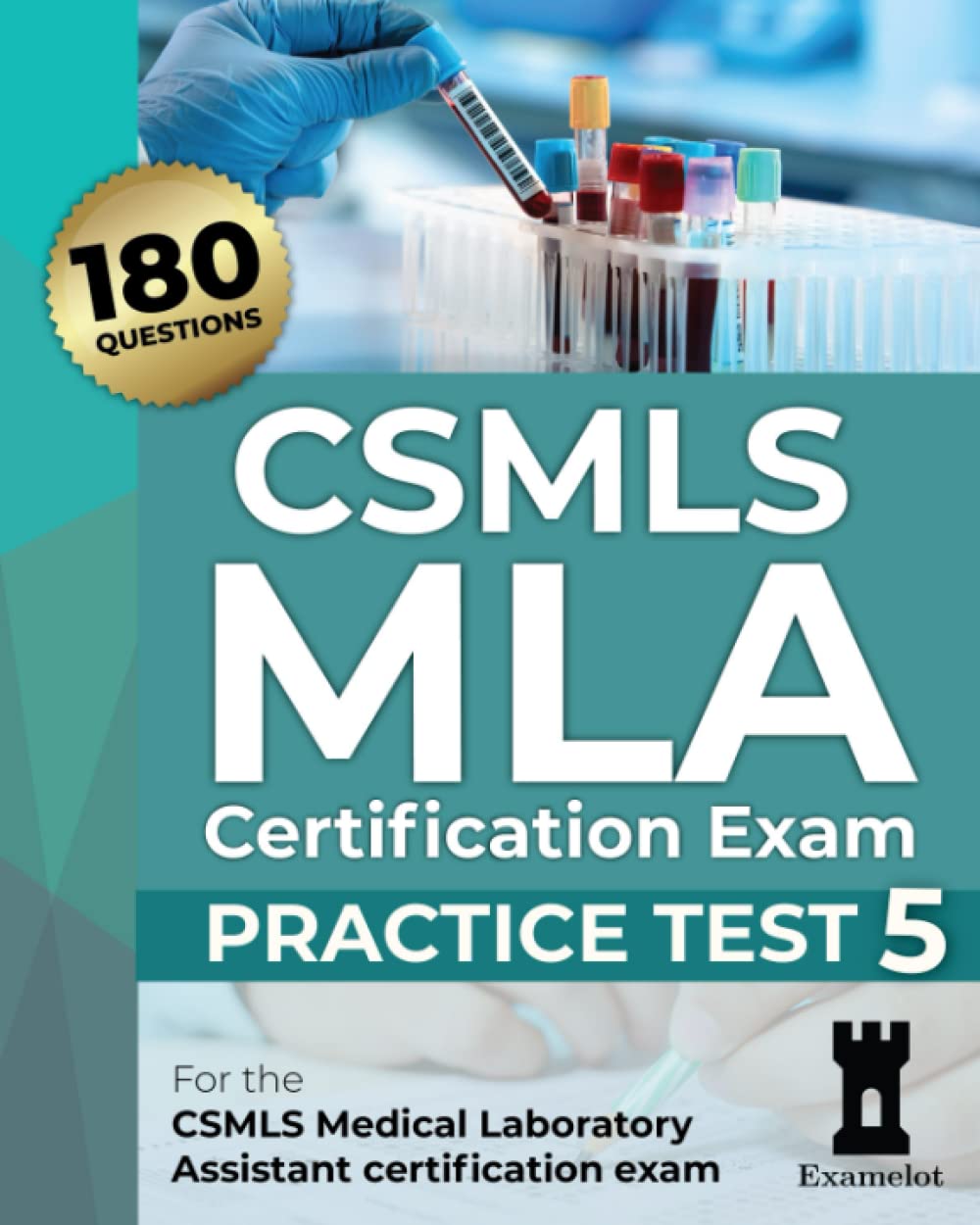
The practice questions and answers are also available as a physical book from Amazon.com.
About the CSMLS MLA exam
What is the CSMLS MLA exam?
The CSMLS MLA Certification Exam is a national exam for medical laboratory assistants (MLAs) in Canada. It tests the basic knowledge and skills needed to work as an MLA.
If you pass the exam, you become certified by the CSMLS. This can help show employers that you have the knowledge to work as an MLA. The exam is not required by law, but many employers may ask for it or prefer it.
The exam is set by the CSMLS (Canadian Society for Medical Laboratory Science).
Who can take the CSMLS MLA exam?
There are four routes to qualify for the CSMLS MLA exam:
- Route 1 is for people who have completed a Canadian MLA educational program. This program must be EQual-accredited and you must take the CSMLS exam within twelve months of graduating from the program. If you graduated more than twelve months ago, then you will need to complete a prior learning assessment (PLA).
- Route 2 is for people who have completed the CSMLS prior learning assessment (PLA) process. The PLA process will assess your eligibility for the exam based on your education, clinical training, and work experience. For more details on the PLA process, go to the CSMLS website (www.csmls.org).
- Route 3 is for people who are already certified as MLAs in British Columbia by the BCSLS or in Ontario by the MLPAO. You must have been certified by BCSLS or MLPAO within the last 5 years.
- Route 4 is for certain internationally-educated General MLT candidates recognised by CSMLS or CAMLPR. These candidates must have tried an MLT route but failed the MLT exam.
You must take the CSMLS MLA exam in Canada, regardless of the eligibility route and testing method (in-person or remotely).
How do I apply for the CSMLS MLA exam?
To apply for the exam, you will need to fill out the exam application form on the CSMLS website.
The CSMLS MLA exam is held several times each year, typically in February, June, August, and October. The registration deadline is around two months before each exam. Check the current exam schedule on the CSMLS website at www.csmls.org.
How much does the CSMLS MLA exam cost?
For Canadian residents, the exam fee is:
- $235 for CSMLS members
- $435 for non-members
For non-Canadian residents, the exam fee is:
- $315 for CSMLS members
- $595 for non-members
(These fees are correct for the 2026 exams. See www.csmls.org for the latest fees.)
Note there is a late fee if you book the exam within the last two weeks of registration. The late fee is $140 for CSMLS members and $145 for non-members.
What is the format of the CSMLS MLA exam?
The CSMLS MLA exam is a computer-based test. It has a 10-minute introduction, followed by 103 minutes to answer the questions. There are 115 questions, which means you have less than a minute to answer each question.
You can take the exam either:
- in-person at a test centre
- remotely at home
What grade do I need to pass the CSMLS MLA exam?
The passing grade is usually 67–68% (see
| Exam date | Score needed to pass |
|---|---|
| February 2024 | 67.2% |
| June 2024 | 68.0% |
| August 2024 | 67.2% |
| October 2024 | 67.2% |
| February 2025 | 68.0% |
| June 2025 | 67.2% |
| August 2025 | 67.2% |
| October 2025 | 67.1% |
| February 2026 | 67.3% |