THE PRACTICE TEST
Practice test at a glance
- Questions
- 300
- Format
- Multiple choice
- Access
- 2 years
- Price
- $39.99
- Answers
- Included
- Explanations
- Included
About these practice questions
These practice questions will help you prepare for the CCBMA Clinical Exam.
This practice test contains 300 practice questions covering the six sections of the CCBMA Clinical Exam:
- Infection Control
- Patient Preparation
- Lab Procedures/Diagnostic Testing
- Patient History
- Administering Medications
- Office Emergencies
All questions have been carefully designed to reflect the questions on the real exam, to help you prepare and get a passing grade.
GET FULL ACCESS
Unlock the full practice test
ONLINE ACCESS
Unlock all 300 practice questions, answers and explanations.
- Immediate access after payment
- One question at a time in practice mode
- Jump directly to any question
- One-time payment
We'll send your purchase information to this address.
Payment is processed by PayPal.
TRY IT FIRST
Sample practice questions
Try some of the questions before buying. Answers and explanations are available with online access.
Section 1: Infection Control
Clean technique Medical asepsis Medical asepsis involves reducing the number of microorganisms to a safe level. This is achieved through hand-washing, cleaning, and disinfection.Sterile technique Surgical asepsis Surgical asepsis is the total absence of microorganisms from a specific area or object. This is achieved through sterilization techniques such as autoclaving or chemical sterilization.
Antibiotics Antiseptics An antiseptic is a chemical applied to living tissue to reduce the risk of sepsis or infection. Disinfectants kill microorganisms from objects.Biocides Disinfectants
Dietrich Hofman Wartenberg Wartenberg wheels, also known as Wartenberg pinwheels or Wartenberg neurowheels, are medical devices for testing nerve reactions.Zimmermann
Blood pressure A sphygmomanometer, also known as a blood pressure monitor, measures blood pressure. It consists of an inflatable cuff which is wrapped around the arm.Body temperature Motor reflexes The density of liquids
A device for delivering gas by mouth A specialised type of medical forceps A tool for looking inside the gastrointestinal tract A tube inserted into the body A cannula is a tube inserted into the body. It is used to deliver or remove fluid or to gather samples.
it is kept in a dark place it is left at room temperature it is not diluted properly Disinfectants are often supplied as concentrated solutions, which need to be diluted to the correct concentration before use. If a disinfectant is not diluted correctly, it may not be effective.the container is kept tightly sealed during storage
Disinfection Disinfection destroys microorganisms, but not usually spores.Eradication Sanitation Sterilization Sterilization destroys all forms of life, including spores.
1:10 dilution of bleach The Centers for Disease Control and Prevention (CDC) recommends a 1:10 dilution of bleach for cleaning large blood spills. Bleach kills most pathogens effectively, including viruses, bacteria, and fungi. For small spills, a dilution of 1:100 can be used.70% isopropyl alcohol Antibacterial soap and water Povidone-iodine
10% ethyl alcohol 40% ethyl alcohol 70% ethyl alcohol Alcohol is most effective as a disinfectant when it is diluted with water to a solution of 60–90% alcohol.100% ethyl alcohol
Autoclavable waste bags Disinfectant Petri dishes Biohazard spill kits contain items for safely cleaning up and disposing of biohazardous materials. This typically includes absorbent material, disinfectant, autoclavable waste bags, gloves, and safety goggles.Safety goggles
When organisms have been killed When sterilization has taken place Autoclave tape does not prove that sterilization was successful.When the autoclave is nearing the end of its warranty When the autoclave reaches a specific temperature Autoclave tape changes color when the autoclave reaches a specific temperature. This tells you at a glance whether an item has been through an autoclave cycle.
A disinfectant A mild detergent Generally, you should wash the inside of the autoclave with a cloth, mild detergent, and warm water. Harsh chemicals and abrasive materials can damage the autoclave.An antiseptic Saltwater
Get a new wrapper If a lab assistant discovers that the wrapper for an instrument has a hole before autoclaving, the instrument should not be sterilized in that wrapper. This is because the hole may allow microorganisms to enter the package after sterilization, leading to contamination of the instrument. The lab assistant should use a new wrapper to package the instrument for autoclaving.Ignore the hole and continue wrapping the instrument Repair the hole with adhesive tape Throw the instrument away
Distilled water Autoclaves require distilled water or deionized water to function properly.Mineral water Saltwater Tap water
Air causes cold spots in the autoclave Air in an autoclave acts as an insulator and could cause cold spots. These cold spots can compromise the sterilization process.Air increases the risk of explosion Any water in the air will dilute the sterilizing agents Steam can break the glassware
Autoclave Autoclaves sterilize equipment by subjecting it to pressurized steam. In comparison, dry heat sterilizers and ovens use hot air for sterilization.Dry heat sterilizer Fume hood Oven
Cleaning Cleaning removes dirt and debris but does not necessarily kill microorganisms.Disinfection Disinfection kills most microorganisms but may not eliminate spores. The spore form of bacteria is difficult to kill with disinfectants.Sanitization Sanitization may reduce the number of microorganisms to a safe level but does not eliminate them.Sterilization Sterilization is a process that destroys all microbial life, including spores. Sterilization methods include moist heat (autoclaves) or dry heat (ovens).
To avoid damaging the oven To ensure complete sterilization If you open a dry-heat sterilizer during sterilization, the sterilizer will cool slightly, and the temperature drop may interrupt sterilization. For this reason, it is important to keep a dry-heat sterilizer closed throughout the sterilization cycle.To prevent moisture from entering the chamber To prevent oxygen from entering the chamber
Autoclaving Autoclaving sterilizes by destroying all microorganisms, including bacteria, viruses, fungi, and spores.Chemical disinfectants Chemical disinfectants destroy many microorganisms, but do not necessarily achieve sterilization and may not be effective against spores.Freezing Freezing doesn't kill microorganisms; it only stops their growth.Soap and water Soap and water reduce the number of microorganisms, but do not kill all of them.
100°C 121°C 140°C 160°C Hot air ovens can sterilize in 30 minutes at 170°C, 60 minutes at 160°C, and 150 minutes at 150°C.
Ready for all 300 questions?
Unlock the full practice testPREFER PAPER?
Get the printed book
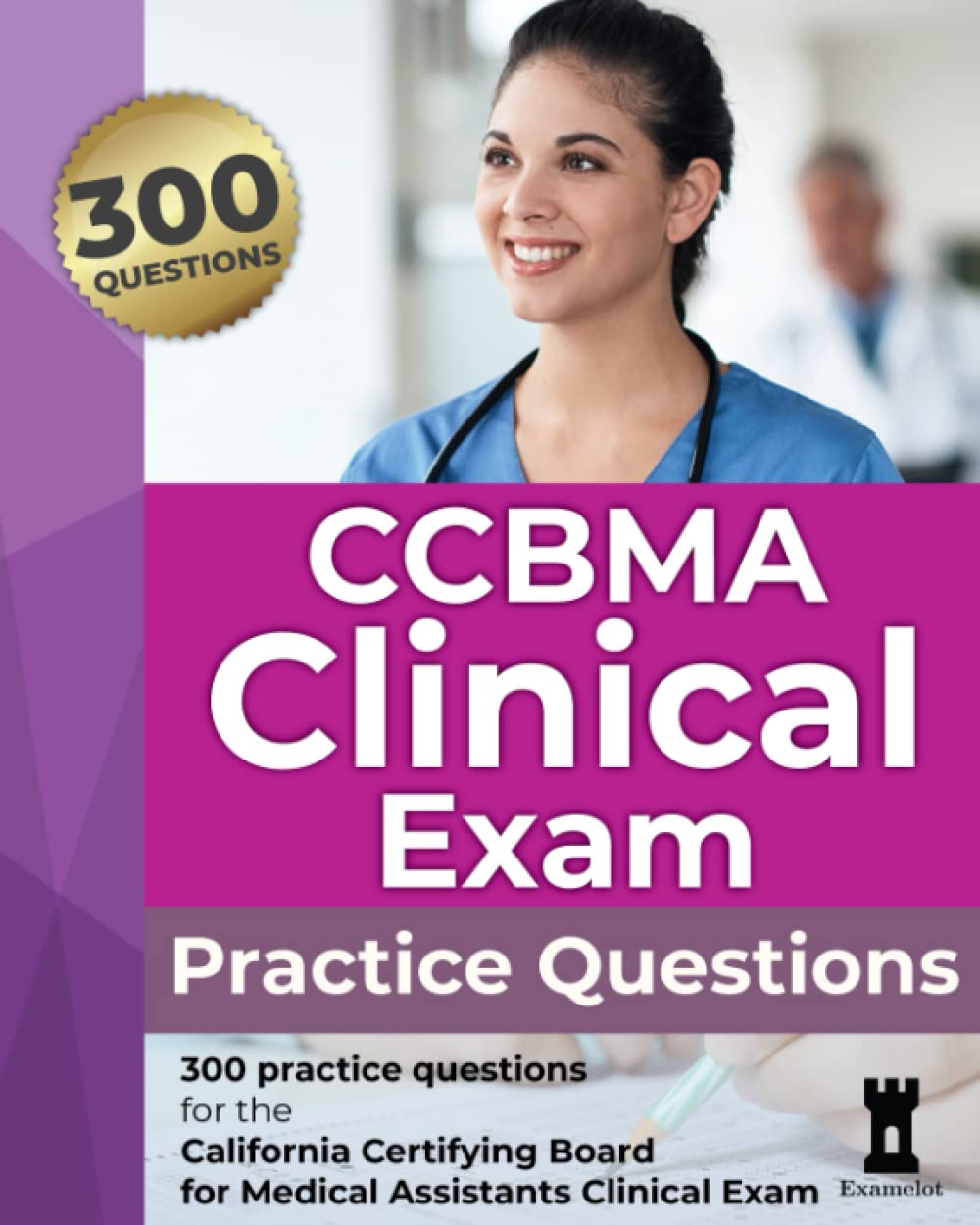
The practice questions and answers are also available as a physical book from Amazon.com.
About the CCBMA Clinical Exam
What is the CCBMA Clinical Exam?
The California Certified Medical Assistant (CCMA) exams are exams that test your knowledge of medical assisting. They are designed for entry-level medical assistants.
The exams are set by the California Certifying Board for Medical Assistants (CCBMA), a private non-profit corporation.
There are three CCMA exams: Basic, Administrative and Clinical. The Clinical exam tests your knowledge of clinical procedures such as administering injections, performing skin tests, and performing venipuncture.
To become certified by the CCMA, you must pass:
- the Basic examination and
- either the Administrative exam or Clinical exam.
Eligibility requirements
To take the CCBMA Clinical Exam, you must be at least 18 years old and have CPR (cardiopulmonary resuscitation) certification. You must also meet one of the following requirements:
- Currently employed as a medical assistant in the United States
- Graduated from an accredited medical assisting program in the United States in the last year
- Have worked as a medical assistant in the United States for two years during the last five years
- Currently employed as a medical assisting instructor in the United States
- Member of the US military with relevant training
How to apply for the exam
You apply for the exam, you must apply online at the CCBMA website (ccbma.org). Upon approval of your application, CCBMA will send you an email with instructions on how to schedule your exam.
What's the exam like?
The exam takes place several times a year at testing centers across California. On your exam day, you'll need to go your local Pearson VUE testing center. The staff there will check your identity document to confirm your identity. There will be a locker for you to keep your belongings. Then you'll be shown to a computer where you'll do the exam.
The Clinical Exam lasts one hour and consists of 125 multiple-choice questions. There are no breaks.
Don't bring calculators to the exam. Calculators will be provided on request at the testing center.
Passing the exam
Passing the exams gives you a CCBMA credential. There are three credentials you can receive:
- Passing the Basic and Administrative examinations gives you a CCMA-A credential.
- Passing the Basic and Clinical Examinations gives you a CCMA-C credential.
- Passing the Basic, Administrative and Clinical Examinations gives you a CCMA-AC credential.
What if I fail the exam?
If you fail the exam, you can retake it two more times. The retake fee is $105.
If you fail a third time, you can only retake the exam again if you work as a medical assistant. If you don't work as a medical assistant, then you'll no longer be able to retake the exam.
What if I need to cancel my exam?
To cancel your exam, you'll need to write to CCBMA at least 15 days before your exam date. You'll also need to contact Pearson VUE to have your scheduled appointment cancelled. After you've cancelled your exam, CCBMA will refund you the application fee minus a $50 processing charge.
What if I need to reschedule my exam?
To reschedule the exam, you'll need to contact Pearson VUE at the phone number found on your eligibility letter.
Structure of the exam
The CCMA Clinical Examination has six sections:
- Section A: Infection Control
- Section B: Patient Preparation
- Section C: Lab Procedures/diagnostic Testing
- Section D: Patient History
- Section E: Administering Medications
- Section F: Office Emergencies
Section A: Infection Control
The first section of the Clinical Exam, Infection Control, is worth 10% of the exam and includes the following topics:
- Asepsis
- Sterilization
- Minor surgery
Section B: Patient Preparation
The second section of the exam, Patient Preparation, is the most important section because it is worth 25% of the exam. The section includes the following topics:
- Vital signs
- Examinations
- Examination instruments
- Body positions
Section C: Lab Procedures/Diagnostic Testing
The third section of the Clinical Exam, Lab Procedures/Diagnostic Testing, is worth 20% of the exam and will ask you quetions about:
- Specimen collection
- Specimen processing
- Screening tests (urinalysis, hematology, pregnancy testing, ECGs, vision testing)
Section D: Patient History
The fourth section of the Clinical Exam, Patient History, is the least important as it is only worth 5% of the exam. It will ask you questions about patient medical history.
Section E: Administering Medications
The fifth section of the exam, Administering Medications, is worth 20% and will ask you questions about:
- Medications
- Side effects
- Drug dosages
- Measurement systems
- Methods of administration
- Prescriptions
- Controlled substances
Section F: Office Emergencies
The final section, Office Emergencies, is worth 20% of the exam and will ask you questions about:
- Emergency procedures
- Emergency equipment
- First aid (bleeding, burns, heart attack, choking, fractures, seizures, and shock)