



THE PRACTICE TEST
Practice test at a glance
- Questions
- 21
- Format
- Multiple choice
- Access
- 2 years
- Price
- $9.99
- Answers
- Included
- Explanations
- Included
GET FULL ACCESS
Unlock the full practice test
ONLINE ACCESS
$9.99
Unlock all 21 practice questions, answers and explanations.
- Immediate access after payment
- One question at a time in practice mode
- Jump directly to any question
- One-time payment
We'll send your purchase information to this address.
Payment is processed by PayPal.
TRY IT FIRST
Sample practice questions
Try some of the questions before buying. Answers and explanations are available with online access.
brain ears eyes Tonometry is a test that checks the pressure inside the eyes.heart
Ear irrigation Pap smear A Pap smear is procedure to collect cells from the cervix to test for abnormalities. A speculum is used to open the vaginal canal and a spatula or cytobrush is used to collect cells from the cervix.Phlebotomy Wound dressing
Manipulation Observation Palpation Palpation involves using the hands and fingertips to feel for abnormalities in the body, such as changes in texture, temperature, or tenderness. It is used to assess the size, shape, and position of organs, and detect masses or abnormalities.Percussion
Auscultation Observation Palpation Percussion Percussion involves tapping on the body to elicit sounds that can help determine the underlying structures. A hollow organ like the lungs will produce a different sound than a solid organ like the liver.
Auscultation Auscultation means listening to sounds in the body, usually with a stethoscope. It is used to evaluate sounds from the heart, lungs, bowels, and other organs.Manipulation "Manipulation" means moving a body part to check the range of motion and flexibility.Mensuration "Mensuration" means measuring things like height, weight, temperature, blood pressure, etc.Palpation "Palpation" means using the hands to feel the body for abnormalities.
Apgar Growth Growth charts plot a child's height, weight, and head circumference on a graph to check the child is growing properly.Medical Pediatric
Pap smear The Pap smear involves collecting cells from the cervix, the lower part of the uterus. The cells are then examined under a microscope to detect abnormalities, including cervical cancer.Pelvic exam Pregnancy test Ultrasound
Digital rectal examination Pelvic exam A pelvic exam is a routine medical procedure performed on women to examine the female reproductive organs, including the uterus, ovaries, and fallopian tubes.Pregnancy test Prostate exam
21°C 32°C 37°C Normal human body temperature is around 37 degrees Celsius (98.6 degrees Fahrenheit).100°C
40–69 mm Hg 60–79 mm Hg 90–119 mm Hg Normal systolic pressure is between 90 and 119 mm Hg.120–139 mm Hg
40–69 mmHg 60–79 mmHg Normal diastolic pressure is between 60 and 79 mmHg.90–119 mmHg 120–139 mmHg
16–18.49 18.5–24.9 25–29.99 The ranges are:- 18.49 and below. Underweight
- 18.5–24.9: Normal
- 25–29.99: Overweight
- 30.0 and above: Obese
30–34.99
4–12 12–20 The normal respiration rate for an adult at rest ranges from 12 to 20 breaths per minute.20–28 28–36
Belsky Korotkoff Korotkoff sounds are heard through a stethoscope while taking a blood pressure measurement. They are named after Russian physician Nikolai Korotkoff, who discovered them in 1905. The sounds are caused by the turbulent blood flow through the arteries as the cuff is slowly deflated.Morozov Turgenev
Fowler’s Prone Sims’ In the Sims' position, the patient lies on their left side, with their left leg slightly bent and their right leg sharply bent. It is also called the lateral recumbent position.The image below shows the Sims' position. 
Supine
Fowler’s Prone Semi-Fowler’s Supine Electrocardiograms (ECG) are commonly performed in the supine position. In this position, the patient lies flat on their back, The supine position ensures the patient's body is stable for accurate readings.
Dorsal recumbent Fowler’s Lithotomy Semi-Fowler’s
Fowler’s Prone Lying face-down on the stomach is called the prone position.Sims’ Supine
Lateral Lithotomy The lithotomy position is used for gynecology examinations. In the lithotomy position, the patient lies down and their legs are raised and separated.Sim's position Trendelenburg
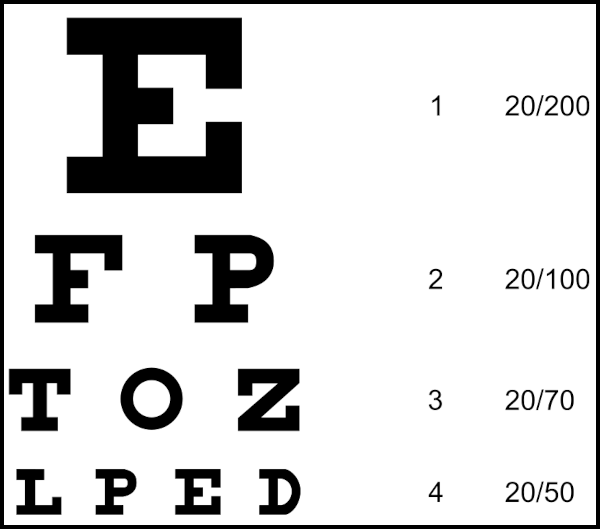
Bakker chart De Vries chart Jansen chart Snellen chart The image shows the top of a Snellen chart. Snellen charts are used to test how well people can see.
OD When recording eye exam results, OS means left eye, OD means right eye, and OU means both eyes.OR OS OU
Ready for all 21 questions?
Unlock the full practice test