X

Report a problem


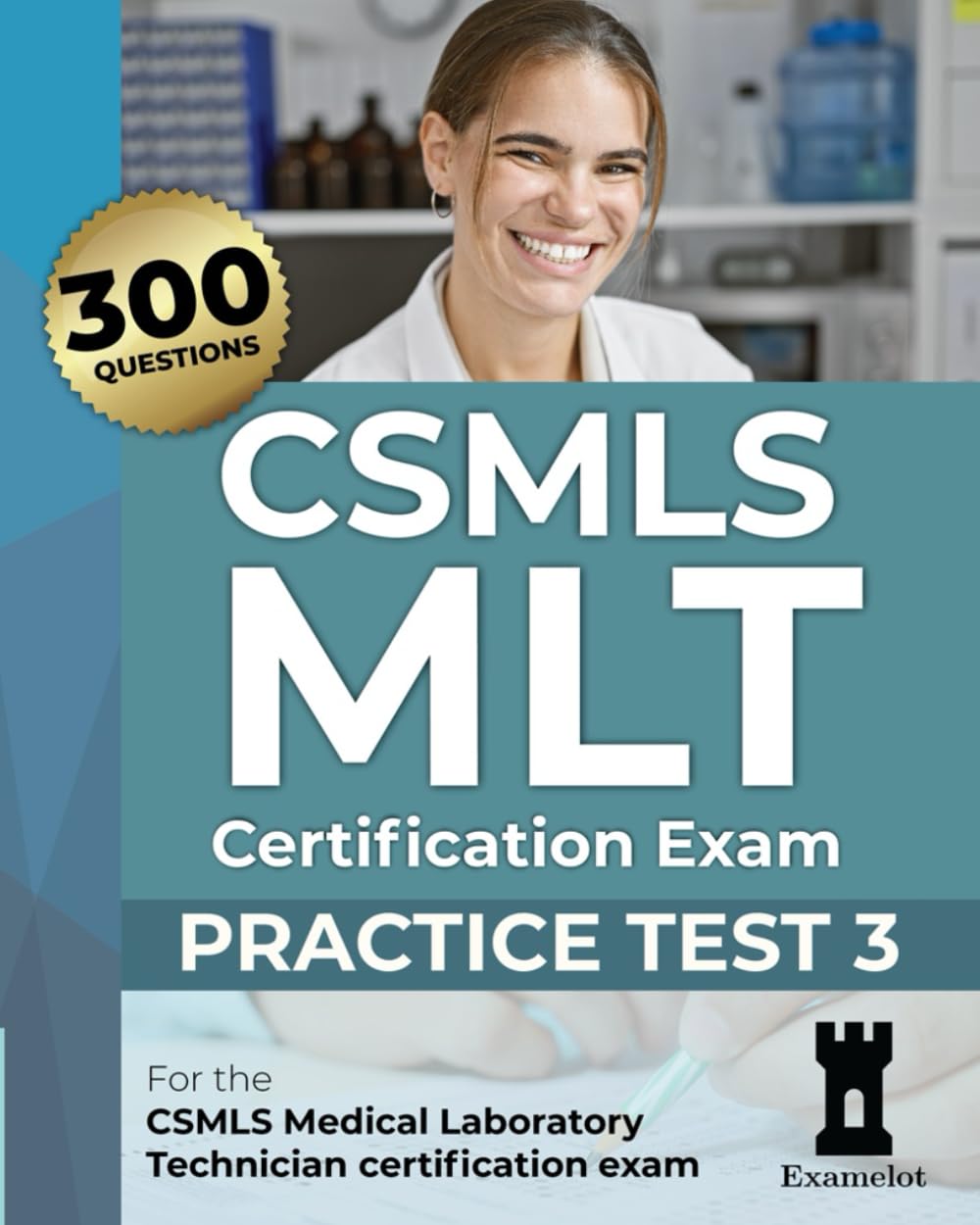
CSMLS MLT Certification Exam: Practice Test 3

This is a preview. Unlock all the questions and answers for just $49.99.

Buy now

About the CSMLS MLT exam

The CSMLS MLT Certification Exam is an examination for laboratory technologists in Canada. The exam is set by the CSMLS (Canadian Society for Medical Laboratory Science).

About these practice questions

These practice questions will help prepare you for the CSMLS MLT exam.

This page contains 300 practice questions divided into the eight sections of the exam: 1. Safe Work Practices, 2. Data and Specimen Collection and Handling, 3. Analytical Processes, 4. Interpretation and Reporting of Results, 5. Quality Management, 6. Critical Thinking, 7. Communication and Interaction, and 8. Professional Practice.

All questions have been carefully designed to mimic the questions on the real exam, to help you prepare and get a passing grade.

Check out all the practice tests in this series: Practice Test 1, Practice Test 2, and Practice Test 3.

Sections

  1. Safe Work Practices
  2. Data and Specimen Collection and Handling
  3. Analytical Processes
  4. Interpretation and Reporting of Results
  5. Quality Management
  6. Critical Thinking
  7. Communication and Interaction
  8. Professional Practice

Section 1: Safe Work Practices

1.1) Category B infectious substances must be shipped with a label that says:
  1. UN 2814 – Infectious Substance, Category B, Affecting Humans
  2. UN 3291 – Clinical Waste, Category B
  3. UN 3373 – Biological Substance, Category B
  4. UN 3549 – Medical Waste, Category B, Affecting Humans
Answers are locked. Please click here to buy them.
1.2) Which federal law sets minimum safety standards for federally regulated workplaces?
  1. Canada Labour Code
  2. Canadian Environmental Protection Act
  3. Public Service Employment Act
  4. Workplace Hazardous Materials Information System
Answers are locked. Please click here to buy them.
1.3) Which act protects the public from public health and safety against risks posed by human pathogens and toxins?
  1. Canadian Environmental Protection Act
  2. Food and Drug Act
  3. Health of Animals Act
  4. Human Pathogens and Toxins Act
Answers are locked. Please click here to buy them.
1.4) How are ethers stored?
  1. In airtight bottles
  2. In the light
  3. In the refrigerator
  4. Underwater
Answers are locked. Please click here to buy them.
1.5) Which concentration of bleach is used to decontaminate benchtops?
  1. 10%
  2. 20%
  3. 30%
  4. 50%
Answers are locked. Please click here to buy them.
1.6) Mercury spills are most dangerous when the spill occurs:
  1. in a fume hood
  2. in a poorly ventilated area
  3. near sources of ignition
  4. near the flammable storage cabinet
Answers are locked. Please click here to buy them.
1.7) Which cleaning product releases a toxic gas when used to clean urine spills?
  1. Chlorine bleach
  2. Hydrogen peroxide
  3. Isopropyl alcohol
  4. Povidone-iodine
Answers are locked. Please click here to buy them.
1.8) An acetone spill occurs on the bench near a lit Bunsen burner. What should be the first action?
  1. Clean up the spill
  2. Move everyone to fresh air
  3. Turn off the flame
  4. Wash eyes with water
Answers are locked. Please click here to buy them.
1.9) What is the first step when cleaning up a blood spill?
  1. Pour disinfectant onto the spill
  2. Put on PPE
  3. Record the incident in the incident book
  4. Wash your hands
Answers are locked. Please click here to buy them.
1.10) What is the greatest risk when opening an autoclave immediately after a cycle finishes?
  1. Burns from hot steam
  2. Electrical shock
  3. Exposure to carbon monoxide
  4. Radiation exposure
Answers are locked. Please click here to buy them.
1.11) What does a number 2 in the blue quadrant of an NFPA hazard diamond indicate?
  1. Continued exposure to the substance could cause temporary incapacitation or injury
  2. The substance can be ignited at normal temperatures
  3. The substance is unreactive with water
  4. The substance reacts with water in an unusual or dangerous way
Answers are locked. Please click here to buy them.
1.12) A lab assistant accidentally drinks a beaker of Zenker's fluid. He says he feels a burning sensation in his mouth and throat. What is the first action you should take?
  1. Call emergency services
  2. Give the lab assistant water to drink
  3. Place the lab assistant in the recovery position
  4. Take the lab assistant outside for fresh air
Answers are locked. Please click here to buy them.
1.13) Which of these helps protect against non-ionizing UV radiation?
  1. Biosafety cabinet
  2. Fire extinguisher
  3. Fume hood
  4. Goggles
Answers are locked. Please click here to buy them.
1.14) How many centimetres deep are chest compressions for CPR?
  1. 2–3
  2. 3–4
  3. 4–5
  4. 5–6
Answers are locked. Please click here to buy them.
1.15) A patient appears to be intoxicated. Her speech is incoherent. Her breathing is rapid. Her pulse is 120. Around her wrist is a diabetic medical bracelet. Which of these actions would be the most appropriate?
  1. Give the patient a glass of water
  2. Give the patient a sugary drink
  3. Give the patient time to recover on her own
  4. Inject the patient with insulin
Answers are locked. Please click here to buy them.
1.16) Which emergency is the chain of survival for?
  1. Cardiac arrest
  2. Diabetic coma
  3. Massive blood loss
  4. Stroke
Answers are locked. Please click here to buy them.
1.17) What should be your first step in the event of a needlestick injury?
  1. Fill out an accident report form
  2. Go to a doctor or hospital emergency department
  3. Report the incident to your supervisor
  4. Wash the wound with soap and water
Answers are locked. Please click here to buy them.
1.18) Which of these items is typically found in a laboratory first aid kit?
  1. Absorbent spill pads
  2. Biohazard bags
  3. Cryogenic gloves
  4. Sterile gauze
Answers are locked. Please click here to buy them.
1.19) When should you NEVER administer care to a casualty?
  1. When the person has stopped breathing
  2. When the person is having a seizure
  3. When the person is unconscious
  4. When the person refuses care
Answers are locked. Please click here to buy them.

Section 2: Data and Specimen Collection and Handling

Section 3: Analytical Processes

Section 4: Interpretation and Reporting of Results

Section 5: Quality Management

Section 6: Critical Thinking

Section 7: Communication and Interaction

Section 8: Professional Practice

Access options

Get online access or buy a physical book.

Option 1: Online access

Unlock the answers to 300 questions for just $49.99

You'll get immediate access after payment.

Step 1

Enter the email address where you want us to send your order to.


Step 2

Select one of the payment buttons below.

Option 2: Physical book

Get the questions as a book

The questions and answers are available as a book at Amazon.ca