Please wait while we confirm your payment. This should take a few seconds...
About the NHA CPT exam
The NHA Certified Phlebotomy Technician (CPT) is a 2-hour exam that will test your knowledge of phlebotomy. Passing the exam serves as proof to employers that you have to knowledge to work as a phlebotomist.
The exam is run by the National Healthcareer Association (NHA). You can find out more about the NHA at www.nhanow.com.
About these practice questions
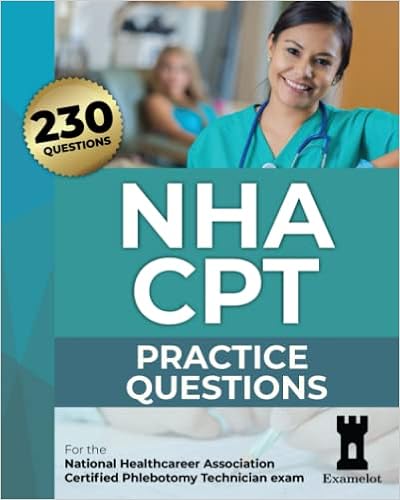
These practice questions will help prepare you for the NHA CPT exam.
This page contains 300 practice questions divided into the five sections of the exam: 1. Safety and Compliance, 2. Patient Preparation, 3. Routine Blood Collections, 4. Special Collections, and 5. Processing.
All questions have been carefully designed to mimic the questions on the real exam, to help you prepare and get a passing grade.
Sections
- Safety and Compliance
- Patient Preparation
- Routine Blood Collections
- Special Collections
- Processing
Section 1: Safety and Compliance
1.1)
Which three kinds of safeguard does the HIPAA Security Rule require?
- Administrative, physical, and technical
- Data protection, cyber security, and non-discrimination
- Operational, digital, and environmental
- Transactional, administrative, and procedural
Answers are locked. Please click here to buy them.
1.2)
What is the main goal of quality management systems in laboratories?
- To automate laboratory work and eliminate human error
- To continuously improve the laboratory processes
- To reduce the cost of laboratory equipment
- To reduce the need for skilled technologists
Answers are locked. Please click here to buy them.
1.3)
A hospital introduces a new blood glucose meter. The laboratory should:
- create a survey for patient feedback
- order new disposable gloves
- revise the daily lab cleaning schedule
- update the quality control procedures
Answers are locked. Please click here to buy them.
1.4)
Which of these is a pre-analytical quality indicator?
- Number of improperly labelled samples
- Number of laboratory reporting errors
- Percentage of results delivered late
- Turnaround time
Answers are locked. Please click here to buy them.
1.5)
Checking and adjusting a measuring instrument against a known standard is called:
- calibration
- estimation
- graduation
- mensuration
Answers are locked. Please click here to buy them.
1.6)
Which of the following is a quality assurance indicator?
- C-reactive protein test
- Fume hoods
- Laboratory turnaround time
- Thorough records of exposure incidents
Answers are locked. Please click here to buy them.
1.7)
A substance with a known value that is used to ensure the validity and accuracy of test results is called a:
- control
- reagent
- reference
- sample
Answers are locked. Please click here to buy them.
1.8)
If a potassium calibration standard is too concentrated, patient results would be:
- falsely high
- falsely low
- less precise
- more precise
Answers are locked. Please click here to buy them.
1.9)
A coworker suggests skipping thermometer calibration because “the thermometer is always accurate.” What is the best response?
- Agree to save time
- Calibrate only if temperatures look wrong
- Explain that calibration is essential for valid results
- Stop using the thermometer entirely
Answers are locked. Please click here to buy them.
1.10)
Where would you find the instructions for running quality controls for a specific assay?
- Laboratory quality manual
- Safety data sheet
- Safety manual
- Standard operating procedure
Answers are locked. Please click here to buy them.
1.11)
The systematic monitoring and evaluation of the entire laboratory testing process is an aspect of:
- corporate compliance
- critical thinking
- quality assurance
- risk management
Answers are locked. Please click here to buy them.
1.12)
Which is an example of external quality control?
- Daily glucose control testing
- Instrument calibration
- Levey-Jennings charts
- Proficiency testing
Answers are locked. Please click here to buy them.
1.13)
Which of these best meets the definition of proficiency testing?
- Inspections to prevent work-related accidents
- Testing for illegal drugs in a biological sample
- Tests to ensure workers have the skills and knowledge to perform their jobs
- The testing of unknown samples sent to the laboratory
Answers are locked. Please click here to buy them.
1.14)
What is the purpose of proficiency testing?
- To evaluate a laboratory's testing accuracy
- To monitor the rate of equipment malfunctions
- To track the inventory levels of laboratory reagents
- To train new employees on laboratory techniques
Answers are locked. Please click here to buy them.
1.15)
ISO and which American organization developed the quality system essentials (QSEs) for laboratories?
- American Clinical Laboratory Association (ACLA)
- American Society for Clinical Laboratory Science (ASCLS)
- Clinical and Laboratory Standards Institute (CLSI)
- Food and Drug Administration (FDA)
Answers are locked. Please click here to buy them.
1.16)
Which of these practices is dangerous and should be avoided?
- Immediately performing first aid on someone who has been exposed to blood
- Recapping used needles using both hands
- Securing used sharps containers during transport
- Using plasticware instead of glass
Answers are locked. Please click here to buy them.
1.17)
Which action could constitute battery?
- Disclosing a patient's health information without consent
- Holding down a patient to draw their blood against their will
- Refusing to draw blood from a patient who arrives late to the appointment
- Spreading malicious rumours about a colleague
Answers are locked. Please click here to buy them.
1.18)
Which of these situations could lead to a civil lawsuit against a healthcare worker?
- Arriving late to work
- Drawing blood without consent
- Refusing to work overtime
- Reporting unsafe conditions
Answers are locked. Please click here to buy them.
1.19)
A patient refuses to have his blood drawn. The phlebotomist threatens the patient with the needle, saying she will draw the patient's blood whether he gives consent or not. The phlebotomist’s action best describes:
- assault
- battery
- fraud
- invasion of privacy
Answers are locked. Please click here to buy them.
Section 2: Patient Preparation
Section 3: Routine Blood Collections
Section 4: Special Collections
Section 5: Processing
Access options
Get online access or buy a physical book.
Option 1: Online access
Unlock the answers to 300 questions for just $39.99
You'll get immediate access after payment.
Step 2
Select one of the payment buttons below.
Option 2: Physical book
Get the questions as a book
The questions and answers are available as a book at Amazon.com
 Examelot